Skip to content
There are few desserts as comforting and nostalgic as a warm, tender bread pudding. It’s that classic American dessert that instantly makes you think of cozy gatherings and sweet, satisfying indulgence. If you’re searching for the perfect bread pudding recipe, one that delivers on both incredible flavor and irresistible texture, then you’ve come to the right place. I’m going to guide you through creating a bread pudding that stands out, ensuring a creamy interior and a delightful crispy top every single time.
Even for beginners, this recipe promises success, transforming humble stale bread into a truly memorable dessert. Get ready to master this comfort food classic!
Why You’ll Love This Recipe
What makes this bread pudding recipe truly special? It’s all in a few clever steps that elevate it from good to absolutely glorious. My secret lies in how we treat the bread and the custard base, ensuring unparalleled flavor and texture.
Toasted Bread Perfection: Instead of simply soaking plain stale bread, I lightly toast the cubed bread pieces with a touch of butter, cinnamon, and brown sugar. This isn’t just for fun; it’s a culinary game-changer. The pre-toasting kicks off the Maillard reaction, developing deeper, nuttier flavors and giving the bread a slightly firmer exterior. This means your bread won’t turn to complete mush in the custard, but rather retain a lovely chew and structural integrity.
Warm, Even Custard Absorption: Another key step is gently warming the milk before mixing it with the eggs and sugar for the custard. This warm milk, combined with a longer 15-20 minute soak time, helps the stale bread absorb the custard more quickly and uniformly. The result? A consistently moist interior that sets beautifully, ensuring every bite is silky smooth and rich.
Ultimate Comfort Food: This bread pudding truly embodies the heartwarming essence of classic comfort food. It’s a nostalgic treat that feels like a warm hug.
Foolproof Texture: Thanks to these techniques, you’re guaranteed a bread pudding with a dreamy, creamy interior and perfectly crisp, golden-brown edges. No soggy bottoms here!
Budget-Friendly & Family-Friendly: It’s an ingenious way to transform leftover stale bread into a gourmet dessert that everyone will adore, making it both economical and a crowd-pleaser.
Ingredients Needed

Here’s what you’ll need to create this incredible bread pudding. Stick to these exact measurements for the best results.
- 6 slices stale bread (Or about 4-5 cups of broken bread pieces or cubes. Some ideas to use are: french bread, buns, rolls, donuts, challah, toast or another type of bread.)
- 3 tablespoons of butter (1 Tablespoon + 2 Tablespoons)
- 4 beaten eggs
- 2 cups milk
- ¾ cup white sugar
- 1 teaspoon vanilla extract
- 1 teaspoon cinnamon
- raisins (optional)
Optional Creamy Vanilla Sauce:
- vanilla sauce (get my vanilla sauce recipe)
Optional Brown Sugar Butter Drizzle:
- 3 tablespoons butter (salted (but unsalted is ok too!))
- 1 tablespoon brown sugar
- 1 teaspoon vanilla extract
- 1-2 tablespoons milk (or heavy cream – optional *see notes)
Ingredient Notes & Substitutions
Let’s dive a little deeper into the ingredients and why they matter for a perfect bread pudding.
Stale Bread: The foundation of any great bread pudding is, of course, stale bread. For this recipe, you want bread that’s firm but not rock-hard. Using `French bread`, `brioche`, or `challah` will give you a richer texture, while even simple `sandwich bread` works wonderfully. Stale bread is crucial because its drier texture acts like a sponge, ready to soak up all that luscious custard without falling apart. To make bread stale quickly, you can leave it out on the counter overnight, or spread cubed bread on a baking sheet and bake at a low temperature (around 250°F) for 10-15 minutes until dried out.
Milk: I recommend using whole milk for a rich, creamy custard. However, for an even more decadent bread pudding, you can substitute some or all of the `milk` with `half & half` or `heavy cream`. The higher `milk fat percentages` will result in a richer, denser custard. Remember, we’ll be warming the milk slightly for optimal absorption, but never let it get too hot, or you risk scrambling the eggs!
Eggs: The `eggs` are key to the `custard`’s structure and richness. Always use `beaten eggs` to ensure they are evenly distributed throughout the mixture, leading to a smoother, more cohesive custard. For the best emulsification and a consistently smooth custard, try to use `room temperature` `eggs`. This helps them blend more easily with the other ingredients.
Sweeteners: This recipe uses `white sugar` in the custard, providing a clean sweetness. The optional drizzle incorporates `brown sugar`, which adds a deeper, molasses-rich flavor. If you’re looking for `diabetic-friendly swaps`, you can experiment with sugar substitutes, keeping in mind that the texture might vary slightly.
Flavorings: `Pure vanilla extract` makes a world of difference in flavor; it’s truly worth the investment for that warm, aromatic note. `Cinnamon` adds a lovely spice that complements the bread beautifully. Feel free to incorporate optional additions like `raisins`, chocolate chips, `chopped pecans`, or other `dried fruit` to customize your bread pudding.
Butter: `Butter` not only adds incredible flavor but also contributes to the rich texture of the bread pudding and helps create that crispy, golden crust on the toasted bread pieces.

How to Make Your Best Bread Pudding
Ready to create a bread pudding masterpiece? Follow these steps closely, and you’ll be rewarded with a truly exceptional dessert.
Prepare Your Baking Dish and Bread
Preheat your oven to 350 degrees F. Take 1 tablespoon of butter and use it to generously coat the inside of your 8-inch square baking dish. This prevents sticking and adds flavor. Next, break your stale bread into the buttered baking dish. I prefer larger, rustic pieces rather than tiny crumbles, as they provide better texture. In a small saucepan, melt your remaining 2 tablespoons of butter, then gently drizzle it over the bread pieces in the dish. This butter will help the bread toast beautifully and absorb the custard.
Craft the Custard and Soak
In a separate bowl, whisk together the remaining ingredients for the custard: your 4 beaten eggs, 2 cups of milk (gently warmed, not hot), ¾ cup white sugar, 1 teaspoon vanilla extract, and 1 teaspoon cinnamon. Make sure the eggs are well beaten before combining them with the other liquid ingredients; this ensures an even, silky smooth custard. Pour this fragrant mixture slowly over the bread, making sure to evenly coat each piece. Gently press the bread down to ensure it’s fully submerged. Let the bread soak in the warm custard mixture for 15-20 minutes. This pre-soak is crucial for maximum absorption and a moist, tender interior.
Bake to Golden Perfection
Once your bread has soaked up all that delicious custard, place the baking dish into your preheated oven. Bake for 45 minutes, or until the top of the bread pudding is beautifully golden-brown and springs back lightly after touching it with a fork. The edges should be bubbling gently, and the aroma filling your kitchen will be absolutely irresistible.
Optional Buttery Brown Sugar Sauce
While your bread pudding bakes, you can prepare an optional, decadent buttery brown sugar sauce. Grab a small saucepan and melt 3 tablespoons of salted butter over high heat. Once melted, turn the heat down to medium and let the butter brown slightly. You’ll see tiny brown bits forming at the bottom and smell a nutty aroma – this is the browned butter magic! Turn the heat down to a simmer. Add 1 tablespoon of brown sugar and 1 to 2 tablespoons of milk (or heavy cream for extra richness). Whisk to combine and simmer for 1-2 minutes until slightly thickened. Remove from heat and whisk in 1 teaspoon of vanilla extract. Serve this glorious sauce over the entire bread pudding in the dish before serving, or spoon it generously over individual servings.
Mastering Bread Pudding Texture & Doneness
Creating the perfect bread pudding is an art, and it hinges on understanding a few key elements, especially when it comes to texture and knowing when it’s just right.
Achieving the Ideal Bread Texture
The type and condition of your bread are paramount. For optimal `custard` absorption, you need `stale bread` that is firm but not rock-hard. This specific texture allows the bread to soak up the liquid without disintegrating, providing structure and preventing mushiness. My unique twist of pre-toasting the bread further enhances this by creating a slight crust and deeper flavor. If your bread isn’t stale enough, simply cut it into cubes and dry it out in a low oven (around 250°F or 120°C) for 10-15 minutes, or leave it exposed to air overnight.
Crafting the Perfect Custard Base
A silky, rich `custard` is the heart of any `bread pudding`. The `eggs` are critical for building structure and `emulsification`. Using `room temperature` `eggs` is optimal because they blend more smoothly and evenly into the `milk` and `sugar`, creating a cohesive and lump-free `custard` base. When I say “beat your eggs first,” it’s not just a suggestion; it’s an essential step to evenly distribute the egg proteins, which helps bind the `custard` and contributes to a smooth final texture. The `milk` provides the liquid base; using `half & half` or `heavy cream` will yield a richer, denser pudding compared to lower `milk fat percentages`. `Sugar` sweetens and tenderizes the `custard`, while `butter` (the fat) enriches the flavor and contributes to a moist mouthfeel.
Knowing When Your Bread Pudding is Done
The “springs back” test is a good indicator, but there are other cues to look for. Your bread pudding is perfectly done when the top is beautifully golden-brown and the edges are gently bubbling. For absolute certainty, insert a clean knife into the center; if it comes out clean, your `custard` is set. Overbaking is a common pitfall that can lead to a dry, rubbery texture. Conversely, `runny custard` means it’s underbaked. If you find dry spots, it might be due to uneven absorption or overbaking; ensure all bread pieces are thoroughly saturated before baking.
Pro Tips & Troubleshooting
Even with the best recipe, a few expert tips and an understanding of common mistakes can make all the difference in perfecting your bread pudding.
Pro Tips for Bread Pudding Perfection
- Stale Bread is Best: This is a non-negotiable! Using `stale bread` (like `French bread`, `brioche`, or `challah`) is crucial as it acts like a sponge, soaking up all the `custard` mixture and preventing a soggy bottom.
- Pure Vanilla Extract: For the most aromatic and delicious flavor, always opt for `pure vanilla extract`. It makes a noticeable difference.
- Pre-Soak Time: Don’t rush this step. Allowing the bread to soak in the warm custard mixture for 15-20 minutes ensures maximum absorption and a truly moist, tender interior.
- For Make-Ahead: Bread pudding is a fantastic make-ahead dessert recipe. You can assemble the entire dish the night before, cover it, and refrigerate. Just remember to let it come to room temperature for about 30 minutes before baking, or add a few extra minutes to the bake time.
- Enriching the Custard: For an even richer, more luxurious `custard`, consider substituting some or all of the `milk` with `half & half` or `heavy cream`.
- Flavor Boosters: Get creative! Add optional `raisins`, `chocolate chips`, `chopped pecans`, or other `dried fruit` to customize the flavors and textures.
Common Mistakes to Avoid
- Using Fresh Bread: Avoid `using fresh bread` at all costs! Fresh bread won’t absorb the `custard` properly and can lead to a dense, soggy pudding where the `custard` settles at the bottom or cooks separately.
- Under-Soaking: If you don’t allow enough soaking time, your bread pudding can end up with dry, unabsorbed spots. Give it that crucial 15-20 minutes.
- Overbaking: Overbaking is the enemy of a creamy bread pudding, leading to a dry, rubbery, or tough texture. Rely on the knife test for doneness.
- Scrambled Eggs: Be careful not to add your `beaten eggs` to milk that is too hot. Warm the `milk` gently, just enough to be lukewarm, to avoid inadvertently cooking and `scrambling` the eggs.
- Improper Pan Size: Using a `baking dish` that is too large or too small can affect your baking time and the final texture. An 8-inch square dish works perfectly for this recipe; if you double it, a 9×13 inch pan is ideal and may require a slightly longer baking time.
Serving & Storage
Once your bread pudding emerges from the oven, fragrant and golden, the delicious journey is far from over! How you serve and store it makes all the difference.
Serving Ideas for Your Delicious Bread Pudding
This `bread pudding` is absolutely divine served `warm`, allowing the `custard` to remain soft and yielding. My favorite way to enjoy it is with a generous drizzle of the warm `browned butter sauce` or a rich, `creamy vanilla sauce` (`crème anglaise`). You can even add a splash of `bourbon` to your vanilla sauce for an adult twist. For classic pairings, a scoop of `ice cream`, a dollop of `whipped cream`, or a dusting of `powdered sugar` are always perfect choices. For extra flair, consider garnishing with `candied nuts` or a drizzle of `caramel ice cream topping`. When it comes to sauce quantity, be generous! Whether serving individual portions or a whole dish family-style, ensure there’s enough luscious sauce for everyone to enjoy.
Storage and Make-Ahead Tips
This `bread pudding` is an excellent `make-ahead` `dessert recipe`. To prepare it the night before, simply assemble the bread and `custard` mixture in your `baking dish`, cover it tightly with plastic wrap, and refrigerate. When ready to bake, let it sit at room temperature for about 30 minutes before placing it in the oven. For `storing leftovers`, ensure the `bread pudding` has cooled completely, then transfer it to an `airtight container` and refrigerate for up to 5 days. For longer storage, `freezing` is an option! Wrap individual slices or the whole cooled pudding tightly in plastic wrap, then foil, and freeze for up to 2-3 months. Thaw overnight in the refrigerator before reheating. To `reheat bread pudding`, you can warm individual portions gently in the microwave or place the whole dish (covered with foil) in a 300°F oven until heated through, which helps maintain its moistness.
Dietary Adjustments & Variations
This recipe is also quite adaptable! If you’re avoiding gluten, `gluten-free bread` can be used interchangeably with traditional bread; the rest of the recipe remains the same. For `diabetic-friendly swaps`, consider using sugar substitutes in the custard and sugar-free chocolate chips or dried fruit if adding them. For a delightful seasonal twist, try swapping out some of the milk for `pumpkin spiced eggnog` during the holidays!
Conclusion
I hope you’re excited to try this ultimate `bread pudding recipe`! By incorporating the simple yet impactful steps of pre-toasting your `stale bread` and gently warming the `custard` base, you’ll achieve a superior taste and texture that truly sets this dessert apart. That crispy top and creamy center are absolutely irresistible.
With all my expert tips and troubleshooting advice, you can create a perfect, `old-fashioned` `comfort food` dessert recipe every time, even if you’re new to baking. So go ahead, give this `bread pudding recipe` a try, share your delicious results with me, and explore some of my other tempting `dessert recipes`!
Frequently Asked Questions about Bread Pudding
How do you know when bread pudding is done?
You’ll know your bread pudding is done when the top is golden-brown and springs back lightly when gently touched. For a definitive check, insert a clean knife into the center; if it comes out clean, the custard is set and ready.
What kind of bread is best for bread pudding?
The best bread for bread pudding is `stale bread` that is firm but not hard. Excellent choices include `French bread`, `brioche`, `challah`, or even leftover croissants or donuts. These breads have a good structure and absorb the `custard` beautifully.
Can I prepare bread pudding the night before?
Yes, absolutely! Bread pudding is a fantastic `make-ahead` dessert. Simply assemble the bread and `custard` mixture in your `baking dish`, cover it tightly, and refrigerate overnight. Let it come to room temperature for about 30 minutes before baking as directed.
How to make stale bread quickly?
To quickly stale bread, cut it into cubes and spread it on a baking sheet. You can either leave it out at room temperature for several hours or overnight, or bake it in a low oven (around 250°F or 120°C) for 10-15 minutes until it’s dried out but not toasted.
How to store leftover bread pudding?
Once your bread pudding has cooled completely, store any `leftovers` in an `airtight container` in the `refrigerator` for up to 5 days. This helps maintain its freshness and prevents it from drying out.
Can bread pudding be frozen?
Yes, `bread pudding` can be `frozen`! After it’s completely cooled, wrap individual slices or the whole pudding tightly in plastic wrap, then an additional layer of aluminum foil. It can be frozen for up to 2-3 months. Thaw overnight in the refrigerator before reheating.
What is day-old bread?
Day-old bread refers to bread that is a day or two past its freshest, meaning it has dried out slightly and become firm. This drying process makes it ideal for absorbing `custard` mixtures in recipes like bread pudding without becoming soggy or mushy.
What size baking dish should I use for different batch sizes?
For this recipe, an 8-inch square `baking dish` is perfect. If you decide to double the recipe, a 9×13 inch pan is ideal. Keep in mind that adjusting pan sizes may slightly alter baking times; a larger, shallower dish might cook faster, while a deeper dish might take longer.
What to serve with bread pudding?
Bread pudding is wonderful served with a variety of toppings. My favorites include `vanilla sauce` (like a `crème anglaise`), a `browned butter sauce`, a scoop of `ice cream` (vanilla is classic!), or simply a dollop of `whipped cream` and a dusting of powdered sugar.
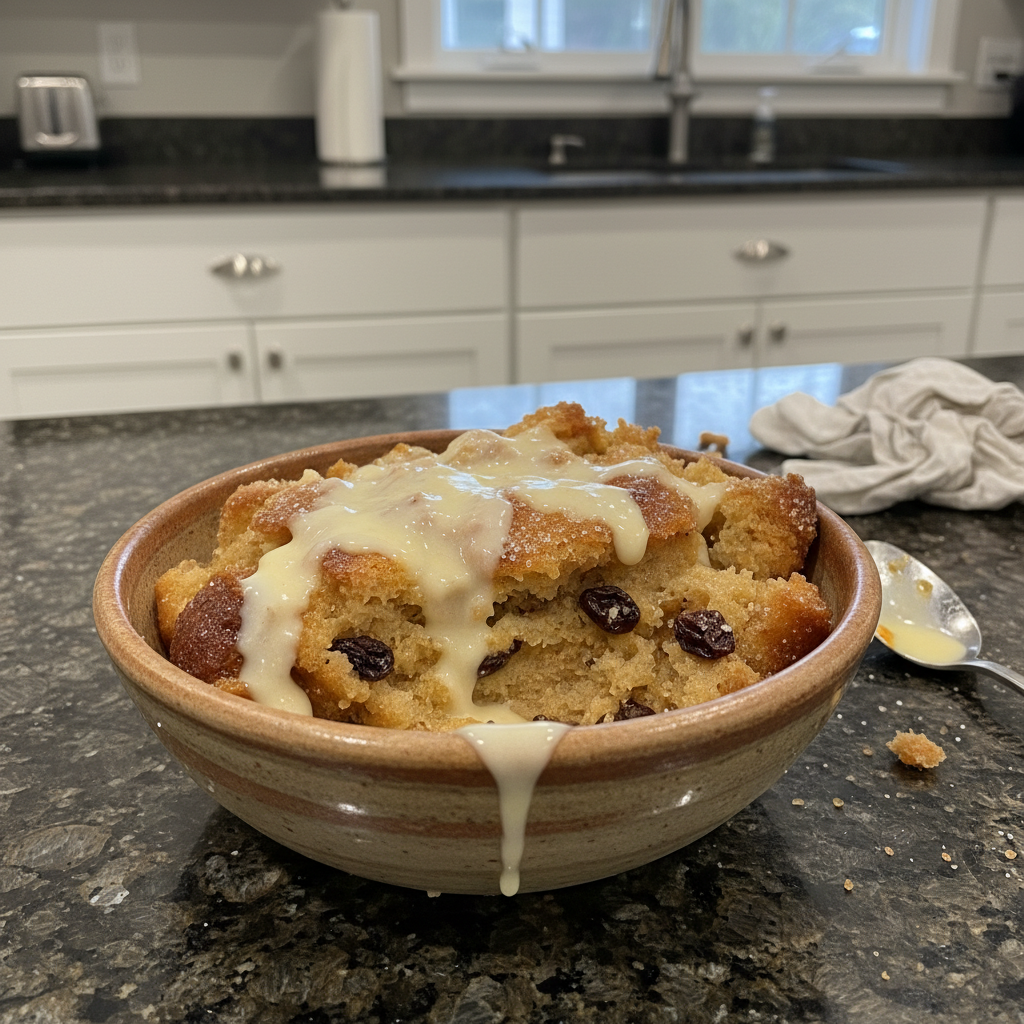
Ultimate Bread Pudding Recipe: Crispy Top, Creamy Center
Ingredients
Equipment
Method
- Preheat your oven to 350 degrees F. Generously coat the inside of your 8-inch square baking dish with 1 tablespoon of butter. Break your stale bread into large, rustic pieces directly into the buttered dish. In a small saucepan, melt the remaining 2 tablespoons of butter, then gently drizzle it over the bread pieces in the dish.
- In a separate bowl, whisk together the 4 beaten eggs, 2 cups of gently warmed milk, ¾ cup white sugar, 1 teaspoon vanilla extract, and 1 teaspoon cinnamon until well combined and silky smooth. Slowly pour this fragrant mixture over the bread in the baking dish, ensuring each piece is evenly coated. Gently press the bread down to fully submerge it. Let the bread soak in the warm custard mixture for 15-20 minutes for maximum absorption.
- Once the bread has soaked, place the baking dish into your preheated oven. Bake for 45 minutes, or until the top is beautifully golden-brown and springs back lightly when touched with a fork. The edges should be bubbling gently.
- While the bread pudding bakes, prepare the optional sauce. In a small saucepan, melt 3 tablespoons of salted butter over high heat. Once melted, reduce heat to medium and let the butter brown slightly until tiny brown bits form and you smell a nutty aroma. Turn the heat down to a simmer. Add 1 tablespoon of brown sugar and 1 to 2 tablespoons of milk (or heavy cream). Whisk to combine and simmer for 1-2 minutes until slightly thickened. Remove from heat and whisk in 1 teaspoon of vanilla extract. Serve this sauce generously over the warm bread pudding.