
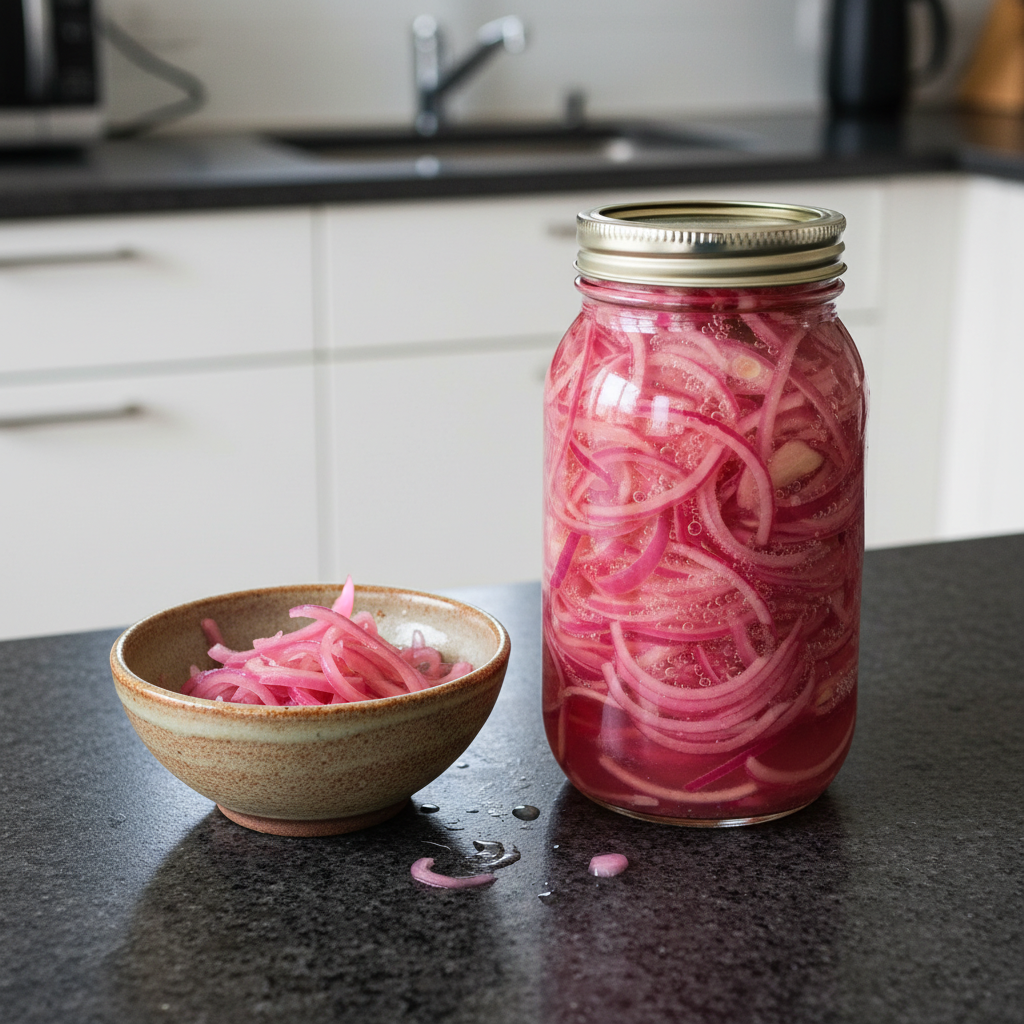
Ingredients
Equipment
Method
Step 1: Prepare Your Jar & Ingredients
- Select a clean, preferably sterilized Mason Jar of appropriate size, typically a 16 oz wide-mouth style.
- Slice the onion uniformly to ensure consistent thickness and even fermentation.
- Place the empty Mason Jar on your Kitchen Scale and press the tare button to zero out its weight. This is crucial for precise salt calculation.
Step 2: Create the Perfect Brine
- Gently fit the sliced onion snugly into the Mason Jar.
- Carefully pour in enough distilled water to completely cover the onions, ensuring you leave some headspace at the top of the jar for expansion.
- Note down the total combined weight in grams of the onion and water in your jar.
- To determine the exact amount of sea salt or pickling salt needed, multiply this total weight by 0.02. This will give you a 2% brine, ideal for beginners.
- Add the bay leaf, mustard seeds, chili flakes (or black peppercorns), and the thin slice of organic carrot to the jar.
- Tare your scale again and add the calculated amount of salt directly into the jar. Secure the lid tightly and shake well to ensure the salt thoroughly dissolves into the brine.
Step 3: Ensure Submersion & Seal
- It is incredibly important to keep your onions completely submerged under the brine to create an anaerobic environment and prevent mold growth. Use dedicated Fermentation Weights, a small pinch bowl, a smaller Mason Jar that fits inside, a plastic sandwich bag filled with a little water, or a clean cabbage leaf placed over the onions to keep them submerged.
Step 4: Ferment at Room Temperature
- Leave your ferment at room temperature, ideally between 68-72°F (20-22°C), and always away from direct sunlight. Direct sunlight can cause undesirable temperature fluctuations.
- Typically, fermentation takes 4-7 days; warmer rooms will speed up the process. You'll begin to notice small bubbles appearing, which is a sign of active fermentation.
- Make it a habit to check your jar once a day to ensure the onions remain submerged. Also, open the lid slightly daily to 'burp' the jar and release any built-up CO2 pressure. This prevents mess and potential jar breakage. Close it tightly again after burping.
Step 5: Fridge Storage for Longevity
- Once your fermented onions have reached your desired tangy flavor and a pleasant crunchy texture, it's time to move them to the fridge.
- The cold temperature will effectively halt the fermentation process, preserving their perfect flavor and extending their shelf life significantly. Your delicious fermented onions will now keep for several months.
Nutrition
Notes
For best results, always use pure sea salt or pickling salt without iodine or anti-caking agents, and chlorine-free water. Keeping the onions fully submerged in brine is crucial to prevent mold. Store your finished fermented onions in the refrigerator for up to 6 months or more. Nutrition information is estimated based on common ingredients and serving sizes and may vary.